
Mixing head
Family of heads that mix polyurethane components before injection.
The point where chemistry becomes product.
Introduction
The mixing head is the central organ of practically every polyurethane transformation process. Polyol and isocyanate arrive separately, pressurized, at controlled temperature; they leave the mixing head as a single reactive mass, homogeneous, with the polymerization clock already running. The quality of this homogenization ultimately determines the quality of the final part — as much as the chemical system itself.
This page brings together the main families of mixing head, the criteria that distinguish one from another, and points to the variant suited to each application context.
Where it fits in the process

The mixing head is mounted directly on the mold (or, in spray applications, attached to the gun). It receives the pressurized streams from the metering units and delivers the reactive mass into the cavity or onto the substrate in fractions of a second. Between shots, material recirculates through the mixing head and returns to the day tanks — the system is always "hot," ready for the next cycle.
This proximity to the mold is a fundamental characteristic: unlike thermoplastic injection molding, there are no long runners between the mixing point and the cavity. Mixing happens at the latest possible moment before the part is formed.
Basic principle
There are two fundamental families of mixing head, distinguished by the physical mechanism of mixing.
High-pressure mixing head (impingement). Dominant in RIM, RRIM, SRIM and derivatives. Polyol and isocyanate streams enter a small chamber at 100–250 bar and collide at opposite angles. The impact energy dissipates as intense turbulence, generating molecular mixing in milliseconds. There are no moving parts to mix the material — the momentum of the streams themselves does the work.
Low-pressure mixing head (mechanical). Used in flexible foams, integral skin polyurethane for footwear, and low-complexity discontinuous rigid foams. Streams enter at low pressure (<20 bar) and an internal rotating impeller mixes the material mechanically. Simpler, cheaper, requires solvent purge between shots to prevent internal cure.
The choice between the two depends primarily on the process, production volume, and chemical system complexity. High pressure is standard for technical and automotive parts; low pressure dominates in high-volume segments with less demanding precision requirements.
Classification matrix
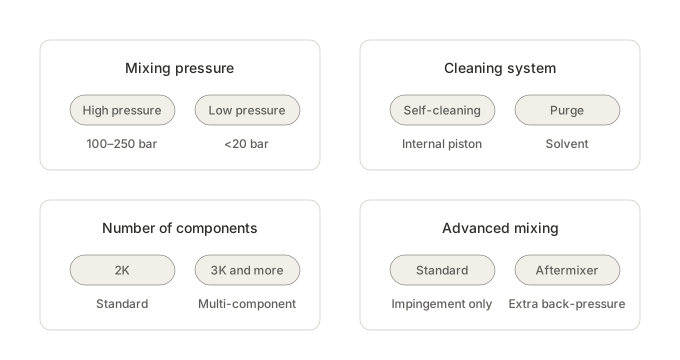
A real mixing head is the combination of a choice on each of the four axes above. Examples:
- Standard automotive mixing head: high pressure + self-cleaning + 2K + standard (no aftermixer). Family of Hennecke MQ, Cannon FPL, KraussMaffei MK.
- Mixing head for integrated pigmentation: high pressure + self-cleaning + 3K + standard. Multi-component variant.
- Mixing head for filled systems: high pressure + self-cleaning + 2K + aftermixer. Typical in RRIM and high-density systems.
- Footwear production mixing head: low pressure + solvent purge + 2K + standard. Market dominated by Asian and specialized Italian manufacturers.
Decision tree
Answer in order:
1. Is the process RIM, RRIM, SRIM, pultrusion or technical application of rigid parts? → Go to high-pressure mixing head (impingement).
2. Is the process flexible foaming, footwear, or low-pressure integral skin polyurethane? → Go to low-pressure mixing head (mechanical).
3. Do you work with high-density systems, mineral or fibrous fillers, or systems that are difficult to homogenize? → Within the high-pressure family, consider mixing head with aftermixer.
4. Do you need to pigment the part during injection itself, or work with systems of 3 or more reactive components? → Consider multi-component mixing head.
These questions are not mutually exclusive. A multi-component mixing head with aftermixer in high pressure exists and is used in premium automotive applications — but the decision always begins with the first question (pressure), because it determines most of the investment and compatibilities of the rest of the system.
Variants
High-pressure mixing head (impingement)
Impingement mixing head operating at high pressure (100–250 bar). Standard for RIM, RRIM and SRIM.
Low-pressure mixing head (mechanical)
Head with rotating impeller and solvent purge. Dominant in flexible foam and footwear.
Mixing head with aftermixer
High-pressure variant with an additional back-pressure chamber. For high-density or filled systems.
Multi-component mixing head
Head for 3 or more reactive streams. Used in integrated pigmentation and tri-component systems.
-
High-pressure mixing head (impingement) — The mainstream family. Used in RIM, RRIM, SRIM. Mixing by impingement of streams, self-cleaning as standard, L-head and MQ geometries as references.
-
Low-pressure mixing head (mechanical) — Internal impeller, solvent purge. Dominant in flexible foaming and integral skin polyurethane for footwear.
-
Mixing head with aftermixer — Variant with additional back-pressure chamber. Indicated for high-density systems, high viscosity, or those with abrasive fillers.
-
Multi-component mixing head — 3 or more reactive streams. Used in integrated pigmentation, tri-component systems, premium automotive class A finish applications.
System integration
The mixing head does not exist in isolation. It is the convergence point of three subsystems:
Metering units (upstream). Provide the pressurized streams, with controlled temperature and throughput. Mixing head and metering unit are sized together — the mixing head's throughput range needs to cover the metering unit's operating curve. See High-pressure metering units and Low-pressure metering units.
Mold (downstream). The mixing head is physically coupled to the mold — the mixing head's outlet is the mold's inlet. Gate geometry, mold clamping pressure, and venting system directly influence the choice of mixing head and vice versa. See RIM molds and Low-pressure molds.
Control (transversal). Modern PLCs control shot, recirculation, mix ratio and temperature through valves and sensors integrated into the mixing head. Premium mixing heads offer plug-and-play integration with the PLCs of major manufacturers; generic mixing heads require customization of the control interface.
Related resources
- Processes using high-pressure mixing heads: RIM, RRIM, SRIM, LFI
- Processes using low-pressure mixing heads: Slabstock, Molded flexible foam, Footwear
- Technical references: Szycher's Handbook of Polyurethanes, 2nd Edition — Chapter 7 (Processing Equipment)
- Glossary: Mixing head, Impingement, Aftermixer, Self-cleaning
Last updated: 2026-04-21. Version 1.0.
Variants in this family
High-pressure mixing head (impingement)
Impingement mixing head operating at high pressure (100–250 bar). Standard for RIM, RRIM and SRIM.
Low-pressure mixing head (mechanical)
Head with rotating impeller and solvent purge. Dominant in flexible foam and footwear.
Mixing head with aftermixer
High-pressure variant with an additional back-pressure chamber. For high-density or filled systems.
Multi-component mixing head
Head for 3 or more reactive streams. Used in integrated pigmentation and tri-component systems.
Talk to a Chemtier specialist
We bring chemistry to your shop floor: technical system recommendations, supply and process support.